
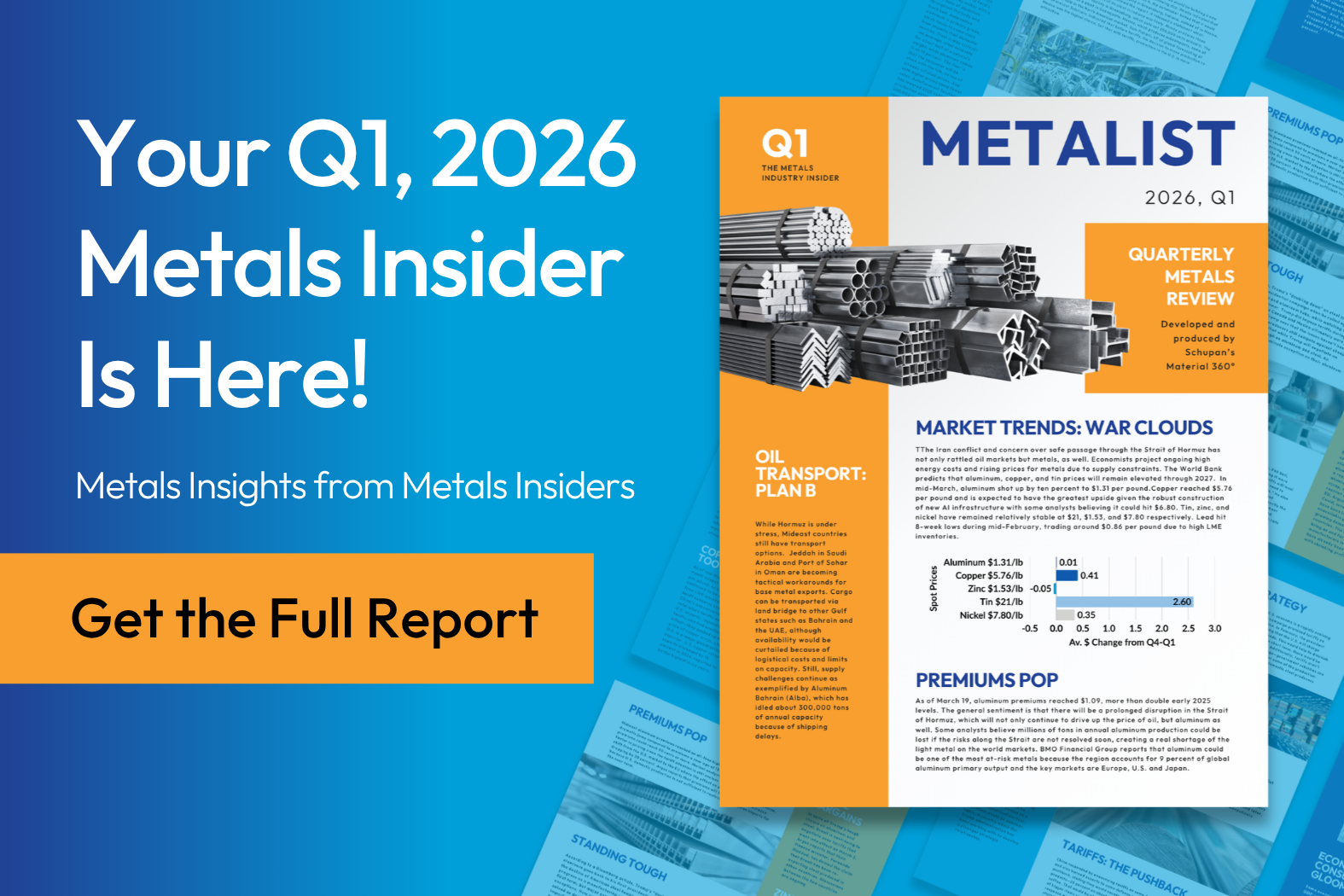
The Q1, 2026 State of Metals Report
Ready to future-proof your metals strategy? The Quarterly State of Metals Report by Shupan’s Material 360° is here to guide you through a transformative year of scrap market shifts, AI innovation, changing trade policies and actionable insights.
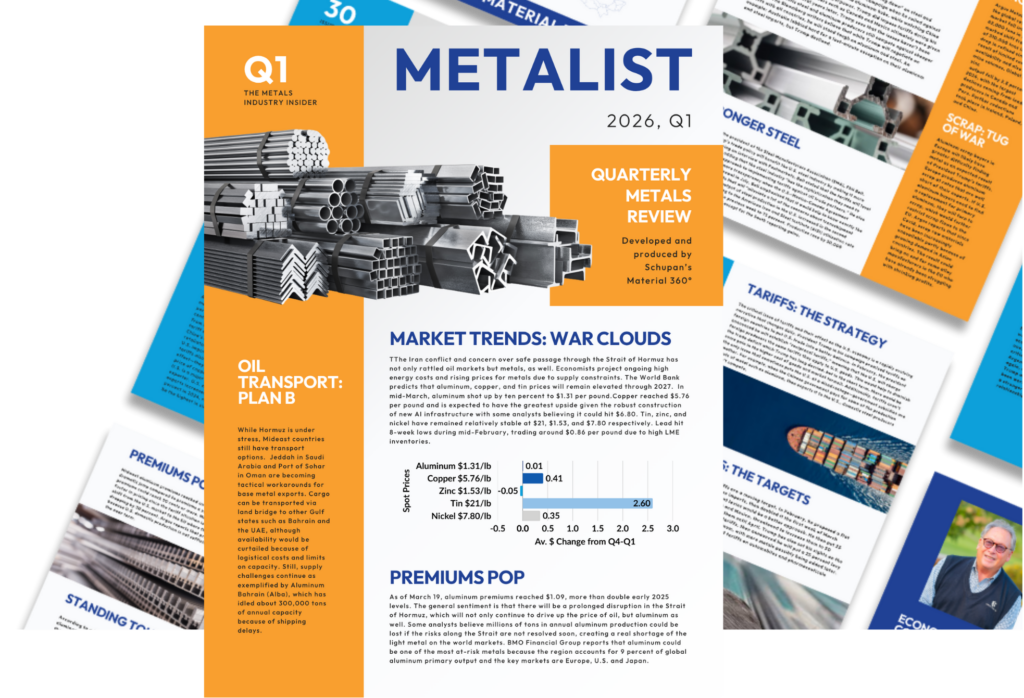
Metals Market Outlook Q1, 2026: Navigating Volatility, Supply Risk, and Opportunity
By: Marc Schupan, CEO of Schupan & Sons, Inc.
The metals market is entering one of the most unpredictable periods we’ve seen in years.
After more than five decades in this industry, I’ve learned that uncertainty isn’t the exception — it’s the rule. But what matters is how you respond to it.
This latest edition of the Metalist breaks down the forces shaping today’s market: geopolitical conflict, rising energy costs, tightening supply, and shifting demand across key industries. These aren’t isolated events — they’re connected, and they’re already impacting pricing, availability, and decision-making.
In this post, I’ll walk through the key signals we’re watching and what they mean for the months ahead.
Download the Full Metalist Report for complete data, pricing, and deeper analysis.
Quick Navigation
Market Trends: A Volatile Global Backdrop
Geopolitics is driving markets right now.
The conflict involving Iran and the ongoing risk to the Strait of Hormuz — a passage responsible for roughly 20% of global oil flow — is creating ripple effects across both energy and metals markets .
As energy costs rise, so do production and transportation costs for metals.
That pressure is already showing up in pricing:
- Aluminum rose sharply, hitting ~$1.31/lb in March
- Copper climbed to ~$5.76/lb, with upside projections near $6.80
- Zinc, nickel, and tin remain relatively stable
- Lead weakened due to high inventories
The key takeaway:
This is not a demand-driven spike alone — it’s supply risk layered on top of structural demand.
Download the full report for detailed price tracking and forecasts.
Copper’s Strength and the AI Infrastructure Boom
Copper continues to send one of the clearest signals in the market.
Demand is being driven by something new — not just construction or manufacturing, but AI infrastructure and data center expansion.
We’re seeing a fundamental shift:
Energy demand is rising because of computing power needs, and copper sits at the center of that equation.
That’s why pricing remains strong — and why long-term demand looks even stronger.
Energy, Oil, and the Ripple Effect on Metals
When oil moves, everything moves.
The volatility we’ve seen — with oil spiking dramatically amid conflict — is impacting:
- Shipping costs
- Insurance costs
- Production economics
- End-market demand (RV, automotive, industrial)
Even industries outside metals are feeling it.
This is a reminder that metals don’t operate in isolation.
They move with energy, policy, and global stability.
Trade Policy and Tariff Uncertainty
Tariffs remain one of the biggest variables in today’s market.
New proposed tariffs under Section 301, combined with prior rulings and ongoing policy changes, are creating uncertainty for buyers and suppliers alike .
We’re also seeing companies get more creative — using strategies like “first sale” valuation to reduce tariff exposure.
The issue isn’t just cost.
It’s predictability.
And right now, predictability is limited.
Shifting Demand: Automotive, Industrial, and Energy Storage
Demand is no longer moving in one direction.
- Automotive demand is mixed, with some slowdown but signs of recovery
- Industrial buyers remain cautious
- Energy storage is accelerating — rapidly
A key example:
Battery manufacturers are shifting focus away from EVs and toward utility-scale energy storage systems, where growth is stronger and more consistent.
This is where metals demand is evolving — not disappearing.
The Growing Importance of Recycled and Critical Materials
Two trends are becoming impossible to ignore:
1. Recycled Metals Are Strategic
Rising energy costs and sustainability pressures are making recycled metals more valuable than ever.
They’re not just an alternative — they’re becoming essential.
2. Critical Minerals Are a Global Priority
The U.S. is investing heavily to compete with China, which dominates refining across most critical materials.
Estimates suggest it could take $1 trillion and a decade to close that gap .
That tells you everything you need to know about where the market is heading.
What This Means for 2026
If I had to sum it up:
This is a market defined by uncertainty — but also by opportunity.
- Supply chains are tightening
- Policy is shifting
- Demand is evolving
- Pricing remains volatile
At Schupan, our focus is simple:
- Keep product moving
- Protect margins through hedging
- Stay disciplined with receivables
- Continue investing in long-term capability
We don’t try to predict everything.
But we do prepare for anything.
Download the Full Metalist Report for deeper insights, data, and forward-looking analysis.
Key Takeaways
- Geopolitical risk is driving both energy and metals markets
- Aluminum faces major supply constraints despite uneven demand
- Copper demand is rising due to AI and energy infrastructure
- Tariffs and policy uncertainty continue to impact decision-making
- Recycled and critical materials are becoming strategic assets
- 2026 will reward flexibility, discipline, and informed decision-making
Final Thought
One of my favorite sayings:
“People who use crystal balls must learn to eat glass.”
No one knows exactly how this plays out.
But experience still matters — and so does staying informed.
We appreciate your business and your trust.
— Marc Schupan

Marc Schupan
Marc Schupan is the CEO of Schupan & Sons, Inc., one of the nation’s leading metal recycling and materials management companies. With over four decades of industry leadership, Marc is known for his sharp economic insights, strategic vision, and commitment to sustainable business practices. He writes regularly about metals markets, manufacturing trends, and the evolving global economy.