
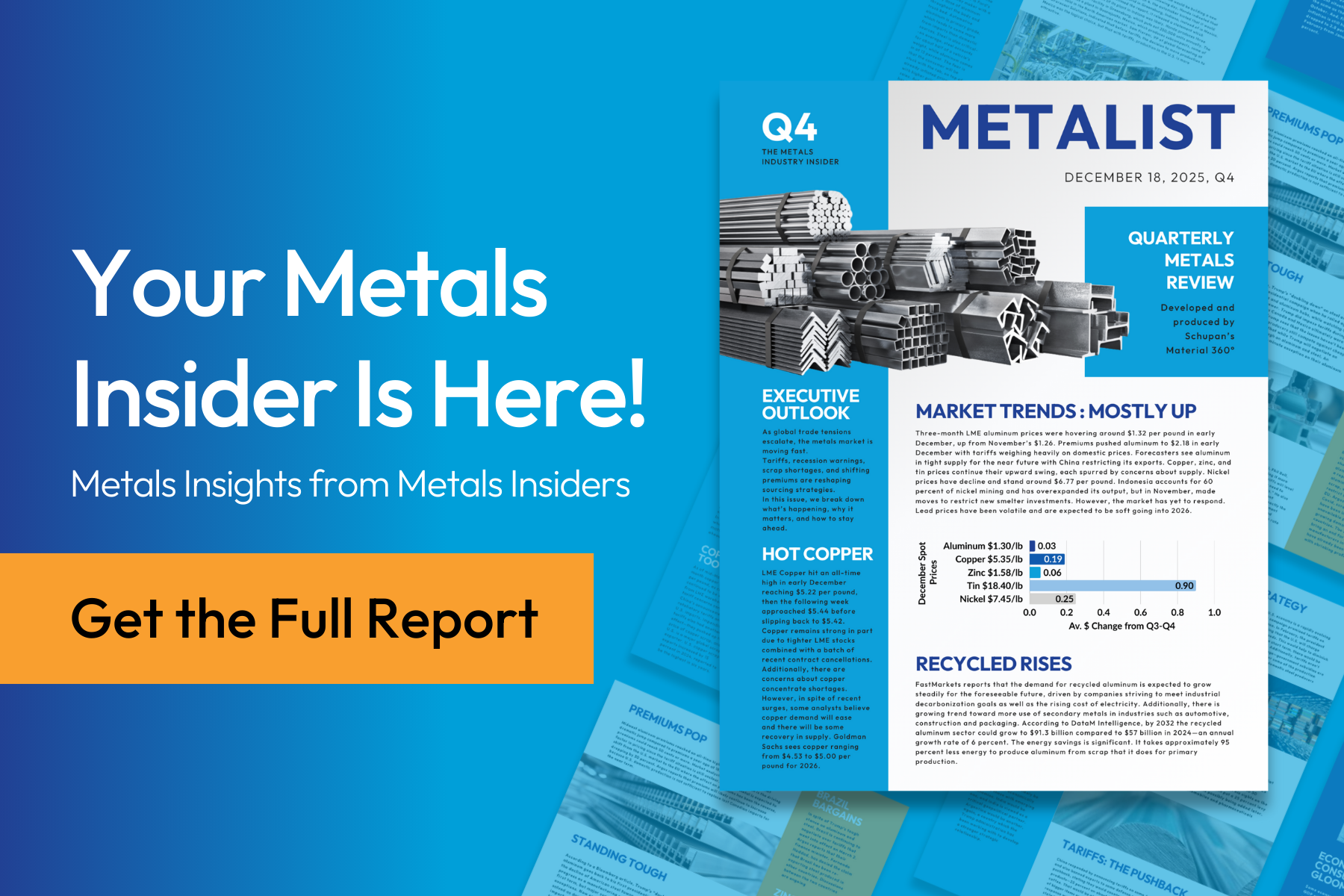
The Q4, 2025 State of Metals Report
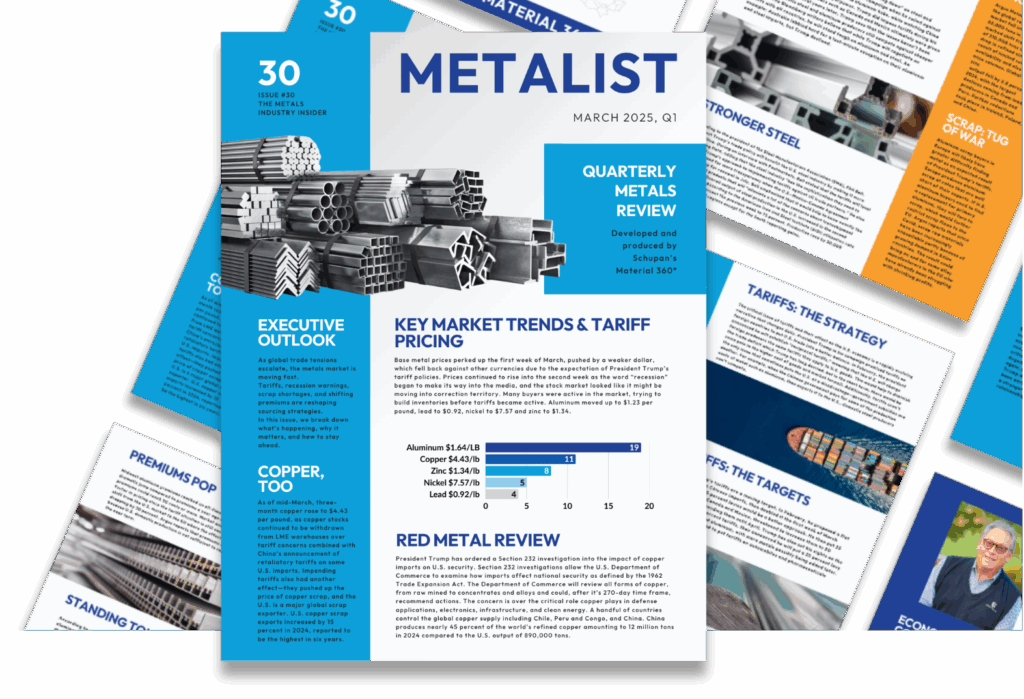
Ready to future-proof your metals strategy? The Quarterly State of Metals Report by Shupan’s Material 360° is here to guide you through a transformative year of scrap market shifts, AI innovation, changing trade policies and actionable insights.
Metals Market Outlook: What Industry Leaders Need to Watch in 2026
By: Marc Schupan, CEO of Schupan & Sons, Inc.
The metals industry rarely offers calm waters.
After more than five decades in this business, I can say that periods like this demand experience, perspective, and steady judgment.
This latest edition of the Metalist reflects a market shaped by a tightening supply, policy uncertainty, sustainability pressure, and rapid technological change.
In this post, I’ll highlight the most important signals we’re watching — and what they mean for manufacturers, recyclers, and procurement leaders heading into 2026.
If you want the full data, commentary, and forward-looking analysis, you can download the complete Metalist report below.
Quick Navigation
Market Trends Across Key Metals
Most base metals closed 2025 with upward pressure.
That momentum has carried into early 2026, supported by supply constraints and long-term infrastructure demand.
- Aluminum remains tight, influenced by export restrictions and tariffs.
- Copper prices surged to record levels late last year, driven by low inventories and grid expansion needs.
- Zinc markets stayed constrained due to low warehouse stocks.
- Nickel and steel scrap remain steady but lack strong demand signals.
Markets today feel less driven by short-term speculation and more by structural shifts — energy transition, geopolitics, and supply discipline.
Think of this cycle less like a spike and more like a tightening spring.
Download the full Metalist for pricing context and forecasts.
Aluminum: Tariffs, Premiums, and Tight Supply
Aluminum continues to be one of the most complex metals to navigate.
By late 2025, Midwest premiums climbed sharply, driven by tariffs layered on top of LME strength.
While demand has been uneven, pricing remains elevated because supply options are limited — especially with China restricting exports and uncertainty around North American trade flows.
One important development:
Low-carbon aluminum has begun to trade at small premiums in the U.S. market. That’s a meaningful signal.
For years, sustainability carried goodwill but not pricing power.
That may be starting to change.
This shift matters for recyclers and manufacturers alike, especially as decarbonization targets become less optional.
Recycled Metals and the Sustainability Shift
Recycled aluminum demand continues to rise — and for good reason.
Producing aluminum from scrap uses roughly 95% less energy than primary production.
That’s not marketing language. That’s physics.
As electricity costs remain high and emissions targets tighten, secondary metals are becoming less of a preference and more of a necessity.
Europe’s push to restrict aluminum scrap exports underscores this reality.
Scrap is no longer just feedstock. It’s a strategic resource.
For companies positioned in recycling, this trend isn’t temporary.
It’s structural.
The full Metalist explores where recycled metals demand is accelerating most.
Trade Policy, Tariffs, and Global Uncertainty
Tariffs remain one of the largest wildcards.
From USMCA inconsistencies to new Mexican tariff measures and pending Supreme Court decisions, many companies are delaying investment and inventory decisions.
That hesitation alone is shaping demand.
In my experience, uncertainty can be just as powerful as policy itself.
Markets don’t like guessing games.
Right now, there are too many open questions.
Automotive and Industrial Demand Signals
Automotive demand is splitting into two clear paths:
- High-end buyers remain willing to pay for fully loaded vehicles.
- Lower-income buyers are increasingly priced out.
SUVs and trucks continue to dominate.
EV demand has softened following incentive changes, impacting aluminum and battery material forecasts.
Meanwhile, industrial demand remains cautious.
Manufacturers are watching rates, tariffs, and global politics closely before committing.
What This Means for 2026
If I had to summarize the year ahead in one phrase, it would be this:
Opportunity with friction.
There are strong long-term tailwinds — infrastructure, sustainability, electrification.
But near-term decisions will require flexibility and discipline.
That’s why we continue publishing the Metalist.
Not to predict the future perfectly, but to help our partners make better-informed decisions in real time.
Download the full Metalist report for deeper analysis, charts, and commentary.
Key Takeaways
- Metals markets remain structurally tight despite uneven demand.
- Aluminum and copper are shaped by policy, sustainability, and infrastructure.
- Recycled metals are gaining strategic importance.
- Tariff uncertainty continues to influence buying behavior.
- 2026 will reward companies that stay informed and adaptable.
Final Thought
After 51 years in this business, I know one thing for certain:
Markets change fast. Experience still matters.
We appreciate your business and your trust.
We’ll continue earning both.
— Marc Schupan

Marc Schupan
Marc Schupan is the CEO of Schupan & Sons, Inc., one of the nation’s leading metal recycling and materials management companies. With over four decades of industry leadership, Marc is known for his sharp economic insights, strategic vision, and commitment to sustainable business practices. He writes regularly about metals markets, manufacturing trends, and the evolving global economy.